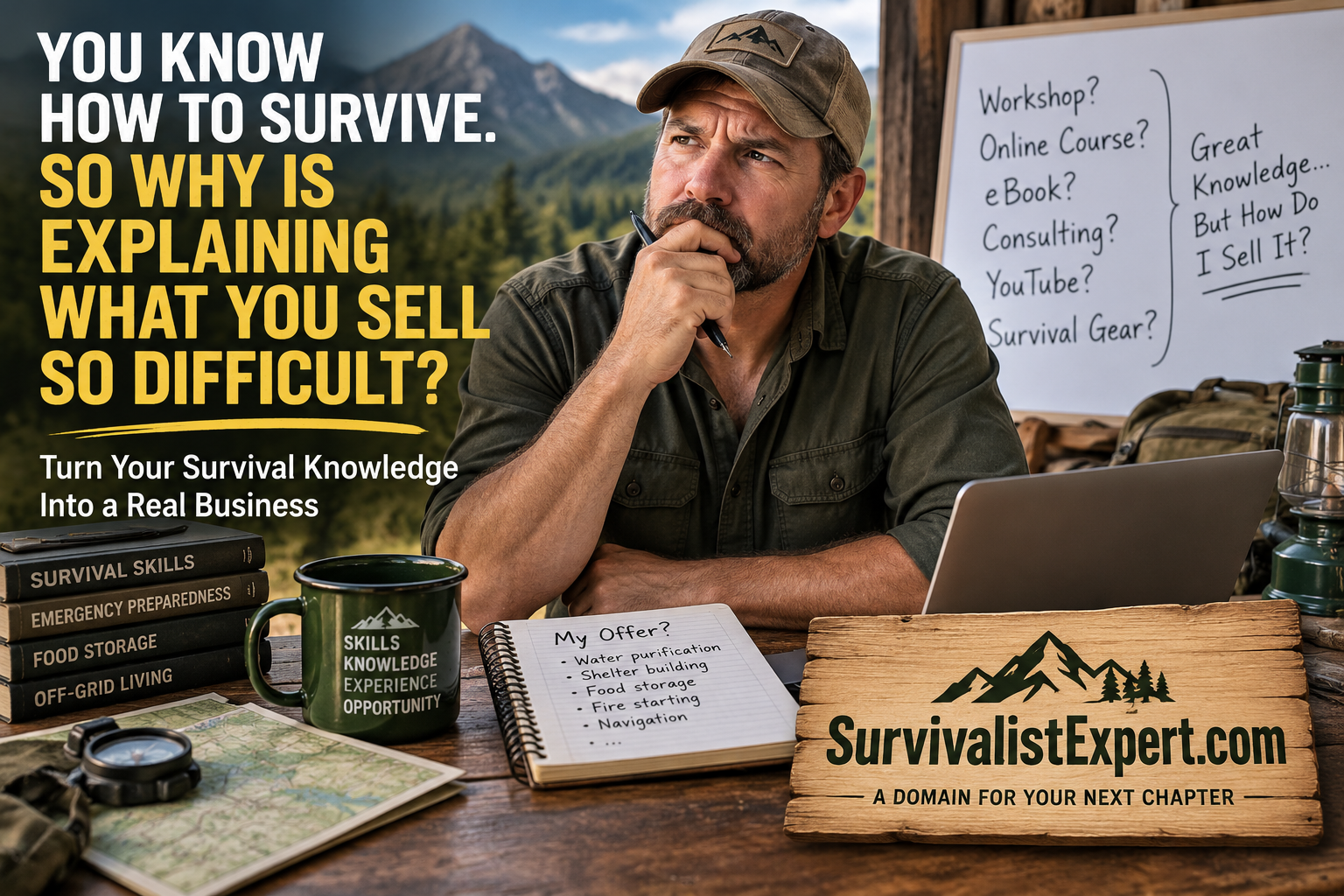
You can explain how to purify water, build an emergency shelter, or prepare for a power outage without checking your notes.
But ask yourself to write a description of a survival workshop you want to sell, and suddenly every sentence feels wrong.
You list your skills. You rewrite the title. You reconsider the price.
Then you look at someone else’s survival course and wonder whether your offer sounds interesting enough.
An hour later, you’re still editing.
You know your subject. You just can’t seem to explain why someone should pay you to teach it.
And that frustration can keep a perfectly reasonable business idea sitting on your computer for months.
The problem starts with everything you know
Imagine you’re creating a beginner’s survival workshop.
You open a blank document and start listing what you could teach:
- Water purification and safe drinking water
- Emergency shelter construction
- Fire-starting techniques
- Food storage and emergency supplies
- Basic navigation and equipment selection
That’s a respectable collection of skills.
You could probably spend an entire weekend teaching them.
But when you read the description, something feels missing.
It sounds like a list of subjects from a survival handbook.
Why would someone pay for your workshop when they can find videos covering those same subjects for free?
You add more details to demonstrate your expertise.
Now the description is longer, but it still doesn’t explain why someone should register.
So you start cutting things.
Perhaps the title needs work. Maybe the price is too high. Maybe you should create an ebook instead.
Before long, you’re reconsidering the entire business.
Your potential customer isn’t thinking about everything you know
Here’s a useful distinction.
You organize your knowledge around skills. Your potential customer may organize their interest around a situation they want to handle.
Consider someone who wants to prepare for an extended power outage.
They might have watched dozens of preparedness videos. They have a flashlight, several cases of bottled water, and a few emergency supplies.
But they still don’t know whether their household is adequately prepared.
They aren’t necessarily looking for a comprehensive education in wilderness survival.
They want to know what they should have ready, what they might be overlooking, and what to do if the power stays out longer than expected.
Now consider two possible workshop descriptions.
Skills-focused description
Emergency Preparedness Workshop
Learn water purification, emergency food storage, shelter techniques, and essential survival equipment.
Situation-focused description
Prepare Your Household for a Three-Day Power Outage
Learn how to assess your emergency supplies, plan for safe drinking water, and identify gaps in your household’s preparedness.
Both descriptions could represent legitimate instruction.
The second gives a particular customer a clearer reason to pay attention.
They can recognize their situation and understand what the workshop intends to help them accomplish.
That doesn’t guarantee they’ll purchase it. But it gives them something more useful than a list of topics.
It gives them a reason to consider whether the instruction is relevant to their needs.
Free information isn’t necessarily your biggest obstacle
It’s easy to become discouraged when you search YouTube for survival skills.
Someone has already demonstrated nearly everything you know.
There are videos about building shelters, purifying water, storing emergency food, and assembling survival kits.
Some are excellent.
You might begin thinking that nobody needs another survival instructor.
But free information and paid instruction can serve different purposes.
A person can watch ten videos about emergency water supplies and still have questions about their own household.
They might want help choosing appropriate equipment, evaluating their current preparations, or practicing a skill with an experienced instructor.
A beginner might also value having information organized into a manageable learning experience.
These are potential reasons someone might pay for instruction. They are not proof that a particular offer has demand.
The important question becomes more specific:
What would someone receive from your particular experience that they aren’t getting from the free information they’ve already found?
Perhaps it’s hands-on practice.
Perhaps it’s personalized guidance.
Perhaps it’s a carefully organized introduction that saves them from sorting through dozens of conflicting recommendations.
Your experience may be valuable because of how you apply it to someone’s needs, not simply because you possess it.
You don’t have to frighten people into buying
Survival marketing presents another uncomfortable problem.
You might see advertisements suggesting that disaster is imminent or that anyone without a particular product is dangerously unprepared.
That approach may feel completely at odds with why you became interested in preparedness.
You want people to develop useful skills.
You don’t want to exaggerate threats, make promises you cannot support, or pressure someone into purchasing something.
Yet when you write a modest description of your own workshop, you worry that it sounds boring.
So you find yourself caught between two uncomfortable choices.
You can describe your offer so cautiously that nobody understands its value.
Or you can imitate promotional language that makes you uncomfortable.
There is another possibility.
Describe a realistic situation, explain what your instruction covers, and make the limits clear.
For example:
“Learn how to assemble and evaluate a basic household emergency kit. We’ll review essential supplies, discuss common planning mistakes, and practice using selected equipment.”
That description doesn’t promise survival in every emergency.
It doesn’t need to.
It explains what participants can expect.
Your credibility can come from demonstrating practical knowledge and being clear about what you can actually teach.
Before rewriting your offer again, answer one question
Suppose you’re considering a downloadable guide about emergency food storage.
You’ve written several pages explaining shelf life, storage containers, food rotation, and meal planning.
But you’re struggling with the title and description.
Instead of rewriting everything, ask:
What specific situation would make someone want this information right now?
Perhaps someone has purchased emergency food but doesn’t know how to organize it.
They keep buying additional supplies because they aren’t sure what they already have.
They worry about food expiring unnoticed.
They want a manageable system they can maintain without spending every weekend checking their pantry.
That situation suggests a more focused guide.
You might create a resource that helps people inventory their emergency food, organize it, and establish a simple rotation schedule.
The content could still draw on your broader knowledge.
But the offer would have a more recognizable purpose.
You could use the same approach with other skills.
A water purification course might address the needs of people preparing for camping trips.
A shelter-building workshop might focus on beginners who want supervised outdoor practice.
A preparedness consultation might help households evaluate their existing emergency supplies.
Each represents a different potential customer and purchasing situation.
You still need to investigate whether people will pay for these offers.
But now you have something specific to investigate.
Give your expertise a business identity without locking yourself into one product
There’s another reason writing your first offer can feel so difficult.
You may be trying to decide what your entire survival business should become before you’ve made a single sale.
Should you specialize in emergency food storage?
Teach wilderness survival?
Create online courses?
Offer private preparedness consultations?
Sell digital guides?
You might have enough knowledge to explore several of these possibilities, but you don’t yet know which one has the strongest demand.
That uncertainty can make every decision feel permanent.
Even choosing a business name becomes difficult.
A name focused entirely on emergency food storage might feel restrictive if you later decide to teach wilderness survival.
A name focused on wilderness instruction might not fit a future preparedness consulting service.
One possibility is to establish a broader professional identity while developing focused offers underneath it.
For someone building a business around survival knowledge, that brings us to a domain worth considering.
A potential business foundation
SurvivalistExpert.com
A domain for a survival education or preparedness business
SurvivalistExpert.com could serve as a central home for an experienced survivalist who wants to develop a recognizable business around their knowledge.
Possible uses include educational articles, survival workshops, downloadable guides, online courses, or preparedness consulting.
A broad domain could allow you to test different offers without building an entirely new brand around each one.
The name communicates an expert-oriented identity, but you’ll still need to establish your qualifications and earn customers’ trust through your work.
Explore SurvivalistExpert.com while it’s still available. (Availability can’t be guaranteed.)
A domain name won’t identify your first paying customer, write your course, or prove that your business idea has demand.
But it can give your work a consistent place to live as you develop and test your offers.
You don’t have to know every product you’ll eventually sell to begin establishing a business identity.
The next time you sit down to write your offer
Open the description you’ve been struggling with.
Look at the list of survival skills you’ve included.
Then consider the person who might purchase your instruction.
What are they trying to prepare for?
What have they already tried?
Where are they still uncertain?
What will they actually learn, practice, or receive from you?
Use those answers to describe one focused offer.
You can still mention your broader experience where it helps establish your qualifications.
But don’t make potential customers figure out how your entire collection of skills applies to their lives.
Give them a clear reason to understand what you’re offering.
Then put the offer in front of real potential customers and learn from their response.
You may discover that the subject needs adjusting, the audience is different from what you expected, or the format isn’t right.
That’s information you can use.
Another evening spent rewriting the same description won’t necessarily give you that information.
Your first offer doesn’t need to represent everything you know about survival. It needs to give a specific person a clear reason to consider paying for something you can genuinely deliver.